
David Klementinowksi was Secretary of ORT Germany in the 1930s before emigrating to France, where he worked for ORT during and after the war, especially with the agricultural schools in La Roche and Lot et Garonne region.
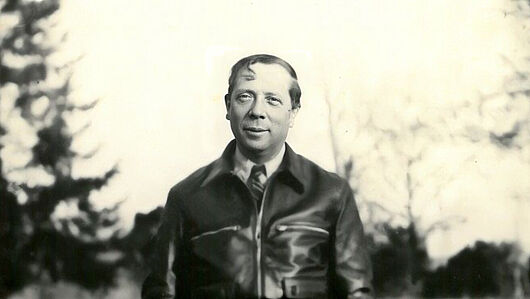
David Klementinowksi first joined ORT in Berlin in the 1920s, where he worked as Secretary of the ORT in Berlin. As part of his work for ORT he was also a member of the [ORT] Committee for Propaganda among Eastern Jews during the late 1920s. He remained in Germany for a number of years after Hitler’s rise to power in 1933, continuing to work for German ORT.
Minutes of an extraordinary general assembly of German ORT in May 1938 mention him among a group of former committee members who had recently emigrated. He then worked for ORT in France, specifically with the La Roche ORT farm school in the Lot et Garonne region during WWII under the German occupation of France. At war’s end he presided as Secretary of the 1946 ORT France conference and continued to be involved with ORT’s agricultural schools in France.
David and his wife Helene (affectionately known as Yenta in correspondence) emigrated to America in 1947 with the assistance of the Hebrew Sheltering and Immigrant Aid Society (HIAS).
David Klementinowski features in various ORT records and publications, but there are no records which give a full account of his role(s) within the organisation. This collection combines ORT 's records, which feature Klementinowsky, along with the Klementinowsky collection, kindly gifted by his grandson, Newton Klements. Newton's own collection of records from his grandfather have provided a greater insight into David's role and the wider significance of the work ORT was doing at this time.
An account of ORT’s early days in Berlin by Dr J. Frumkin mentions him joining ORT Berlin in the 1920s, though no precise date is given:
‘In 1920 Dr. Lvovitch arrived in Berlin from Paris. He asked me, in the name of the Russian ORT Delegation which consisted of himself and Leon Bramson, to organize an ORT Committee in Berlin. I knew Mr. Lvovitch from 1912 in St. Petersburg when he had conducted an intensive campaign for the organization of an Immigrant Bank. I knew him, as well, from the Information Office which had functioned in St. Petersburg for the Jewish members of the Douma. He had performed invaluable services in transferring documentary materials from this Information Office to foreign countries, exposing himself to great danger. I immediately accepted his offer and proceeded with the organization of the Berlin ORT Committee. The main objective of this Committee was to provide the Jewish artisans of Lithuania and Poland with machines and tools. We also had to prepare for the Conference of the ORT Committees from various countries which came to establish the World ORT Union. The first Berlin ORT Committee of which I was chairman, was not very large. It consisted of Dr. A. Syngalowski, Mr. S. Gourevitch, a well known social worker from St. Petersburg, Engineer Schwartz, and others. Dr. Syngalowski's brilliant qualities and his reputation amongst the German Jewish leaders meant much for the Berlin ORT Committee. He became the moving force of this committee. If I am not mistaken, it was in the year 1921 that Professor S. Frankfurt joined us. Then D. Klementinofsky and others came into our ranks.’
Dr J. Frumkin, ‘Stages of ORT Activities’, in Material and Memoirs: Chapters for the History of ORT, Geneva, 1955
![Minutes of first plenary session of the 'Administration Centrale' [Central Board/Council] meeting in Paris, January 1934](/fileadmin/_processed_/2/1/csm_capture.2jpg_c3f656fced.jpg "Minutes of first plenary session of the 'Administration Centrale' [Central Board/Council?] meeting in Paris, January 1934")
At the first plenary session of the 'Administration Centrale' [Central Board/Council] meeting which took place in Paris in January 1934. David Klementinowsky spoke as Director of ORT in Germany before he travelled to Paris. It was noted the absence of the Berlin Office was painfully felt.
‘The local German ORT, under Chairman Wilhelm Graetz and Secretary David Klementinowsky, and the Reconstruction Fund continued their activities. The local ORT, however, now addressed itself, as it had not at first, to the native Jewish communities. Its efforts were devoted to vocational training, sometimes in cooperation with local Jewish communal centers.’
Leon Shapiro, The History of ORT, p174.
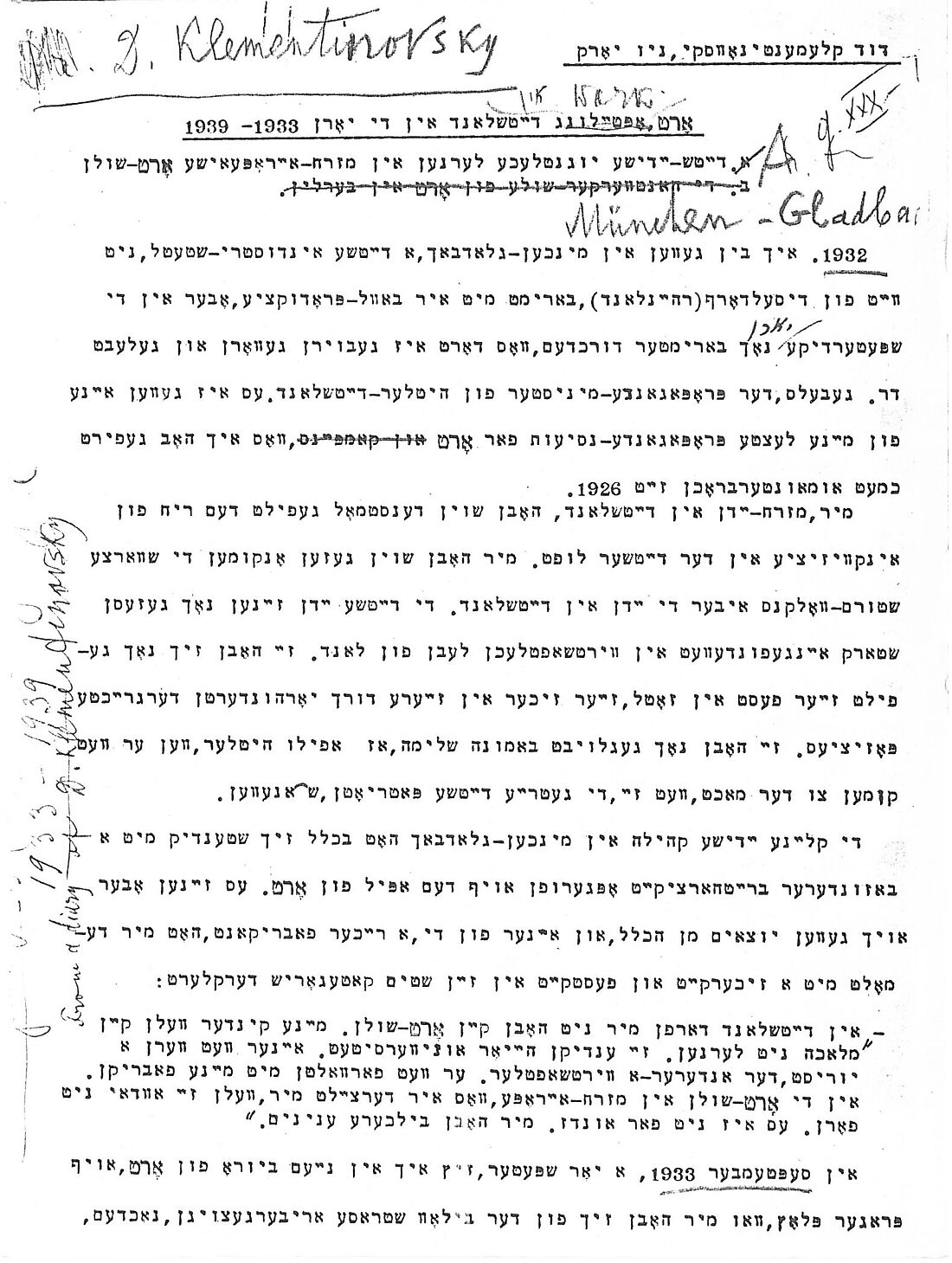
Copy of annotated report on ORT's work in Germany under the Nazis. Includes a description of the opening of the Berlin ORT school in July 1937.
‘The ORT farm in the Department of Lot-et-Garonne merits particular attention. The project was a small one, involving about 80 families. But it was little short of a miracle that in occupied France it was possible for ORT to continue, until 1943, an effort originally begun as a project for German refugees. P. Mine Alexander, a labor leader later affiliated with the Bund in Paris, has told the story of the ORT farm in La Roche under the occupation. The farm was administered by D. Klementinowski, with the agronomist Osher Malkin, later the head of Mikva Israel in Israel, as technical director. La Roche became an oasis for many Jewish families who for a time found not only a refuge but a warm Jewish atmosphere in which they could even observe the Jewish holidays. Both Bramson and Syngalowski visited La Roche and participated in cultural evenings there.’
Leon Shapiro, The History of ORT, p.196.
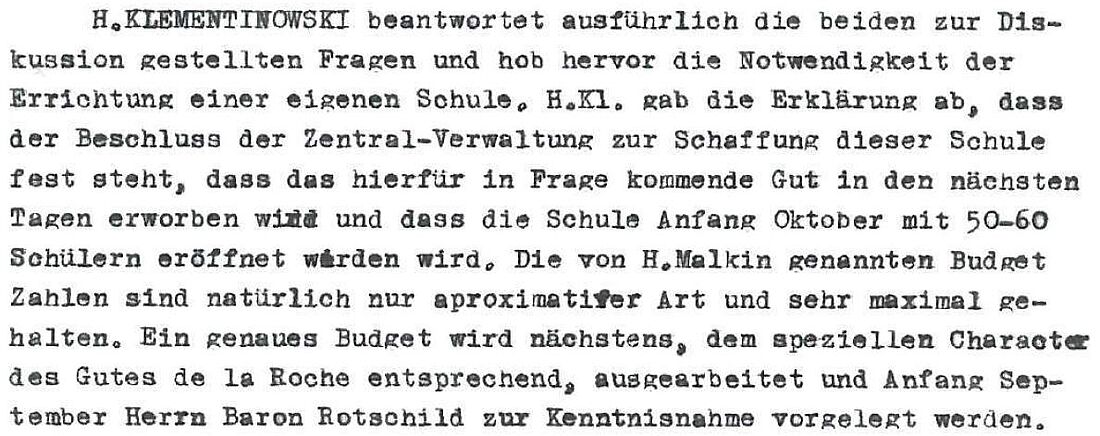
A memo of a meeting which took place in the home of Baron Robert Rothschild in Paris in July 1939 reflects Klementinowski involvement with La Roche. Participants were: Baron Rothschild, Agronomists Bernhard & Brunswig of Alliance Israelite, Heilbronne of Central Refugee Committee, Agronomists Malkin and Klementinowski of ORT Union and Gamzou, General Secretary of ORT France.
It was decided to establish an agricultural school in Lot et Garonne. Rothschild questioned the budget and asked if it might not be better to place the students in existing schools at an annual cost of 3000 to 3500 Francs. Klementinowski replied that that the decision had already been taken to create a school, and that the relevant property had already been purchased and that 50-60 students would start in the October. It concludes with Rothschild's promise to support this venture.
This likely is in reference to the La Roche farm school set up in the Lot-et-Garonne area in 1940. Klementinowski was described as an ‘administrator’ of the school. This project was initially begun as a haven for German refugees, and explains Klementinowski’s involvement.
Finally, minutes of an ORT France conference on 22-23 December 1946 have Klementinowski as the Secretary of the Conference and he is mentioned with regards the ORT France agricultural schools. David Klementinowski in this meeting notes the strains of being understaffed and the welcomed initiative by ORT Switzerland in creating 3 courses to train tutors to teach ORT courses and suggested ORT employees be brought together to exchange idea and experiences so they can improve their skills and learn from each other.
"Mr Klementinowski stresses the importance of the Professional Learning Centres, which will enable many young Jewish people, especially those living far from the ORT centres, to be taught. Our organisation is very popular in France at the moment. All Jewish charities are keen to cooperate with us in the field of constructive aid. They are looking to us for broad plans of work and we must not disappoint their hopes.[...]"
Archive ref: d12a102